Epi-On vs Epi-Off Cross-Linking: Which Is Right for You?
Published · Updated
Short answer: Both aim to do the same thing: strengthen the cornea so that keratoconus stops getting worse. The difference is the surface layer of the cornea. Epi-off removes it, and epi-on leaves it in place. Researchers do not yet know whether one method works better than the other. A major review found no clear difference between older epi-on methods and epi-off, but the evidence was very uncertain. The new epi-on treatment, Epioxa, has not been compared head-to-head with epi-off. In the US, the epi-off drug is also being phased out. The right choice depends on your age, your corneal thickness, what your clinic offers, and what your insurance covers.
Key Takeaways at a Glance
- Epi-off removes the surface layer of the cornea. Epi-on keeps it. Both aim to stop keratoconus from getting worse.
- A major review found no clear difference between older epi-on methods and epi-off. The evidence was very uncertain, and it does not cover Epioxa.
- Epi-off has the longest track record. It also causes slightly more haze or scarring. The epi-off drug is being phased out in the US.
- Epioxa has not been compared head-to-head with epi-off. Its trials followed eyes for 12 months and did not include anyone over 65.
- Choose with a cornea specialist, based on your age, thickness, progression, history, availability and coverage.
The Basic Difference
Cross-linking uses vitamin B2 (riboflavin) drops and UV light to strengthen the cornea. It is the only treatment known to slow keratoconus.
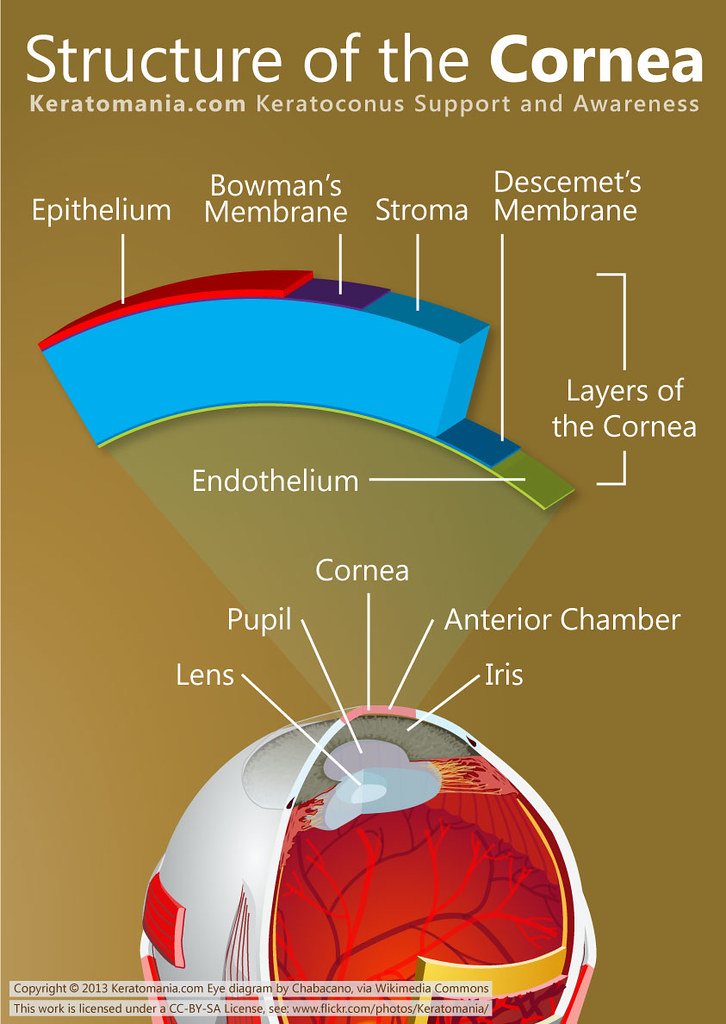
Epi-Off (Epithelium-Off)
Removes the surface layer, so that the riboflavin can soak into the cornea more easily. It is the older and more commonly used method.
Epi-On (Epithelium-On)
Also called transepithelial, this keeps the surface layer in place. Researchers expected this to bring faster healing, less discomfort, faster visual recovery and less risk of haze. The label for Epioxa also adds extra oxygen during the UV step.
What the Research Says
The Cochrane review. Cochrane reviewers looked at 13 randomized trials with 661 eyes. They compared older epi-on methods with epi-off. The results were:
- There was no evidence of an important difference in Kmax (the steepest point of the cornea) after 12 months or longer. The certainty of this evidence was very low.
- There was little to no difference in corrected vision.
- Corneal haze or scarring was slightly more common after epi-off cross-linking. The certainty of this finding was moderate.
- The reviewers concluded that it is not known whether either method is better, and that longer trials are needed.
A 2023 analysis. Another meta-analysis found no significant difference at 12 months in corrected vision or in Kmax. It also found that the results varied a lot between studies, and that most studies did not report side effects.
Why these results have limits. The Cochrane evidence ends in January 2020, so it does not include Epioxa. The trials were done in Europe, the Middle East, India, Russia and Turkey, and they used older epi-on methods. So they cannot tell us how Epioxa compares.
How Epioxa Compares With Older Epi-Off Trials
Epioxa was tested against a sham (pretend) procedure in two trials. Treated eyes were about 1.0 D flatter than sham eyes. The older epi-off treatment was tested against sham in earlier trials. Those reported larger average differences at 12 months, of 1.9 D and 2.3 D.
Be Careful With Cross-Trial Numbers: The trials were separate, with different patients and methods, and they were not designed to compare the two treatments. No head-to-head trial of Epioxa and epi-off has been reported in the published studies reviewed. Read Epioxa explained for more.
Side Effects and Recovery
- Epi-off: In the older trials, common problems included haze, surface scratches, striae (fine lines) and surface defects. Most cleared up within a month. Some took 6 to 12 months to clear, and 1% to 2% of patients still had a surface defect or a scar at 12 months.
- Epioxa: In the label’s trials, a red eye was the most common effect (31%). Between 5% and 25% of eyes had effects such as haze, light sensitivity, punctate keratitis (small surface scratches), eye pain or irritation. In the published trial, there were no serious eye problems, and most effects were mild and short-lived.
Researchers hoped that keeping the surface layer would mean less discomfort and faster healing. But the Cochrane review found too little solid data to confirm this. Ask your clinic what recovery to expect for the method it offers.
Side-by-Side Comparison
| Feature | Epi-Off (Older Method) | Epi-On (Epioxa) |
|---|---|---|
| Surface layer | Removed | Stays in place |
| Track record | Longest follow-up, including 10-year data | Two sham-controlled trials followed for 12 months |
| Average effect in trials versus sham | 1.9 D and 2.3 D at 12 months | About 1.0 D at 6 to 12 months |
| Thin corneas | Special methods exist below 400 microns | UV step not used below 325 microns |
| Availability in the US | Being phased out in 2026 | Launched in March 2026, at clinics with the matching equipment |
| Head-to-head trial | None found | None found |
Remember that the two effect sizes come from different trials and cannot be compared directly.
How to Choose
You and your cornea specialist can weigh these things:
- Is your keratoconus getting worse? Cross-linking is recommended for keratoconus that is getting worse. It also works better when it is done early.
- Your age. Epioxa is approved for ages 13 and older. In its trials, no one aged 65 or older was included.
- Your corneal thickness. This can decide which method is possible.
- Your history. Epioxa is not for people who are allergic to its ingredients or who have certain artificial lenses. It needs caution after a herpes eye infection.
- What your clinic offers. The older epi-off drug is being phased out, and Epioxa needs special equipment.
- Cost and insurance. Coverage differs by method and plan. Read How much does keratoconus treatment cost? and Will insurance pay for cross-linking or scleral lenses?
- Your doctor’s experience with each method.
What We Still Do Not Know
- Which method is better in a head-to-head trial.
- How well Epioxa works over many years. The trials followed eyes for 12 months.
- How it works in people over 65.
- Whether one method lowers the chance of needing a transplant.
Questions to Ask Your Cornea Specialist
- Do you offer epi-on, epi-off or both? Which do you recommend for me, and why?
- Is my keratoconus getting worse? Should I be treated now?
- Is my cornea thick enough for each method?
- What side effects and recovery should I expect?
- How many cross-linking treatments have you done?
- What will it cost, and will my plan cover the method you recommend?
Common Questions
Is epi-on less painful?
Researchers expected less discomfort. But the Epioxa label lists eye pain among its common effects, in 5% to 25% of eyes.
Is epi-on as effective as epi-off?
That has not been proven. The Cochrane review found no clear difference for older epi-on methods, but the evidence was very uncertain. Epioxa has not been compared head-to-head with epi-off.
Is epi-off still available?
The epi-off drug is being phased out in the US. It remains available for individual cases when a doctor decides epi-off is medically necessary. Ask your clinic what it offers.
Which method has more long-term evidence?
Epi-off. For example, a 10-year follow-up of the US trials found that most keratoconus eyes stayed stable, although that group was small. A French study presented at a research meeting reported that 5.7% of eyes needed repeat cross-linking or a transplant by 10 years.
Related Keratomania Guides
Medical Sources & References
- Ng SM, Ren M, Lindsley KB, Hawkins BS, Kuo IC. Transepithelial versus epithelium-off corneal crosslinking for progressive keratoconus. Cochrane Database of Systematic Reviews. 2021;3:CD013512. doi:10.1002/14651858.CD013512.pub2. PMID: 33765359.
- U.S. prescribing information for Epioxa HD and Epioxa, revised October 2025 (published on Drugs.com Professional). Epioxa: package insert / prescribing information. drugs.com (accessed November 14, 2026).
- EyeWorld magazine, Fall 2026 issue. Feature on epithelium-on cross-linking, the Epioxa launch and the phase-out of epi-off Photrexa. digital.eyeworld.org (accessed November 14, 2026).
- Meta-analysis comparing epithelium-off and epithelium-on corneal crosslinking in keratoconus (12-month CDVA, Kmax and corneal thickness). Graefe’s Archive for Clinical and Experimental Ophthalmology. 2023. doi:10.1007/s00417-023-06287-8.
- Beckman KA, Parkhurst GD, Lee JH, et al. Randomized, controlled study to evaluate the safety and efficacy of oxygen-enriched epithelium-on corneal cross-linking for the treatment of keratoconus. Ophthalmology and Therapy. 2026;15(4):1463–1484. doi:10.1007/s40123-026-01364-7. (Summarized by Ophthalmology Management).
- ClinicalTrials.gov protocol document NCT03245853. Epi-on corneal crosslinking for keratoconus: study protocol, section 1.2 Prior experience. ClinicalTrials.gov PDF (accessed November 14, 2026).
- Greenstein SA, Yu AS, Gelles JD, Huang S, Hersh PS. Long-term outcomes after corneal cross-linking for progressive keratoconus and corneal ectasia: a 10-year follow-up of the pivotal study. Eye & Contact Lens. 2023;49(10):411–416. doi:10.1097/ICL.0000000000001018. PMID: 37565471.
- Review of Optometry. Crosslinking for keratoconus shows low failure rates long term, study says. Reports an ARVO 2026 abstract: Garcin T, Hamrani M, Bouheraoua N, Borderie V. reviewofoptometry.com (accessed November 14, 2026).
- Deshmukh R, Ong ZZ, Rampat R, et al. Management of keratoconus: an updated review. Frontiers in Medicine. 2023;10:1212314. doi:10.3389/fmed.2023.1212314.
- Glaukos Corporation (press release). Announcement of commercial availability of Epioxa. March 19, 2026. businesswire.com (accessed November 14, 2026).
- American Academy of Ophthalmology, EyeNet Magazine (Ophthalmic Pearls by Nuzbrokh Y, Rosenberg E and Nattis A; edited by Jeng BH). Diagnosis and management of keratoconus. aao.org (accessed November 14, 2026).